28 Gaming Stocks to Watch in 2026 — Ranked by Review-Score Sensitivity
We track 28 game publishers across 8 exchanges. Most people fixate on EA and Nintendo, but the real opportunities are pure-play publishers where a single game launch can move the stock 10-25%.
Gaming stocks worth watching in 2026 aren't necessarily the ones you'd expect. Most people think EA, Nintendo, maybe Activision before the Microsoft acquisition. The big names. The obvious ones. But those aren't the stocks that move 10-25% on a single game review. Those are the ones that shrug it off because gaming is one division among many.
We built Nydar's game stocks tracking system to cover 28 publishers across 8 global exchanges. After months of mapping review events to stock reactions, one pattern became clear: the less diversified the company, the more the stock moves on game reviews. And the companies that move the most are the ones most people haven't heard of.
According to Newzoo's 2023 Global Games Market Report, the global games industry generated $187.7 billion in revenue. That's bigger than the film and music industries combined. Yet the number of pure-play publicly traded game publishers — the ones where review scores actually move the stock meaningfully — is surprisingly small. We track all of them.
What Makes a Gaming Stock Sensitive to Review Scores?
Revenue concentration. A gaming stock's sensitivity to review scores is almost entirely determined by how much of the company's revenue depends on new game launches versus other business lines. The higher the concentration, the bigger the stock move.
For a company where gaming is 80%+ of revenue and one AAA title can represent 30-60% of expected annual earnings, a single review event changes the financial outlook. When that title reviews 15 points below expectations, analysts revise sales forecasts down 20-40%. On a $2B market cap company, that's $80-160M of expected revenue gone before the stock even opens. Fear and momentum amplify from there.
For a diversified company like Sony — where gaming sits alongside semiconductors, music, pictures, and financial services — one bad PS5 exclusive barely registers on the balance sheet. Same review event, completely different stock reaction.
That's why we split the 28 publishers into tiers.
Tier 1: The Pure-Play Publishers That Actually Move
These are companies where gaming is the core business and a single launch can make or break the year. Review events move these stocks 10-25%.
CD Projekt (WSE: CDR)
The textbook example. The Witcher and Cyberpunk are essentially the entire company. When Cyberpunk 2077 reviewed at 53 on consoles against an expected 92, the stock fell 9.4% on review day and 75% over the following months. When The Witcher 3 crushed expectations, the stock went on a multi-year run.
CD Projekt is the poster child for review-driven stock moves because there's nowhere to hide. One franchise, one set of expectations, everything rides on it. The Warsaw Stock Exchange listing adds another dimension — CDR trades during European hours while most major review embargoes lift on US time. That delay creates the kind of information-price gap that the game stocks widgets are designed to catch.
What makes CD Projekt especially interesting is the redemption arc. After the Cyberpunk launch disaster, they went heads-down on patches and the Phantom Liberty expansion. When Phantom Liberty reviewed well, the stock recovered significantly. For pure-play publishers, the review-to-stock relationship works in both directions.
Capcom (TSE: 9697)
Monster Hunter and Street Fighter drive the business. When Monster Hunter: World scored 90 and broke out in Western markets in 2018, Capcom stock more than doubled over the year. They've got several strong franchises — Resident Evil, Devil May Cry, Monster Hunter, Street Fighter — but they're all gaming. No semiconductor division, no music label absorbing the blow.
Capcom's consistency is unusual for a Tier 1 publisher. According to Metacritic data, their major franchise entries have averaged above 80 over the past decade. That consistency means when they do miss — if a Resident Evil entry underperforms — the deviation from expected is particularly shocking to the market.
Krafton (KRX: 259960)
PUBG. That's the story. Krafton is essentially a single-franchise company trading on the Korean exchange. Their market cap lives and dies with PUBG's engagement metrics and whatever their next major title delivers.
Krafton is also a good example of why you need to watch the Korean exchanges specifically. KRX has different trading mechanics, different retail investor behaviour (Korean retail is famously active in gaming stocks), and different hours. When a PUBG update launches badly and Korean gaming forums light up, the stock can move before any Western analyst has written a note. The Reddit sentiment tools capture Western social signals, but Korean-language forums are often the leading indicator for Krafton specifically.
Embracer Group (OMX: EMBRAC B)
Complicated. Embracer went on an acquisition spree — THQ Nordic, Gearbox, Crystal Dynamics, Eidos — then the Saudi Aramco deal fell through in 2023 and the stock got hammered. They're restructuring and spinning off divisions. But the core thesis holds: when you own that many studios and gaming is the only business, major launch outcomes move the stock.
Embracer is a cautionary tale about what happens when a pure-play publisher's strategy falls apart independent of reviews. The stock collapsed not because of bad reviews, but because financing disappeared. Important reminder: review events are one catalyst among several. Earnings surprises, failed deals, and management changes can overwhelm the review signal.
Team17 (LSE: TM17)
The Overcooked and Worms publisher, plus indie publishing deals. Small-cap, UK-listed, entirely gaming-dependent. The stock reacts to both their own launches and broader indie publishing sentiment.
Small-cap gaming stocks are where the review thesis gets most volatile. Lower liquidity means bigger percentage moves on less volume. A surprise hit from one of their indie partners can spike the stock more dramatically than a comparable event at EA. The flip side: wider spreads and harder exits, which matters if you're trading around a review event in real time.
Paradox Interactive (OMX: PDX)
Crusader Kings, Stellaris, Cities: Skylines. Paradox has a loyal niche audience and a DLC-heavy business model. Their stock moves on launch reviews, but also on post-launch DLC reception.
Cities: Skylines II is the case study. The first game was a massive success with an 85 Metacritic. The sequel launched to mixed reviews and brutal Steam user scores — "Mostly Negative" at launch due to performance issues. The stock took a hit not just on review day, but on a slow bleed as negative reviews kept piling up. Paradox is unique because their DLC model means the review window never really closes. Every major expansion is another catalyst.
Kadokawa (TSE: 9468)
The parent company of FromSoftware. When Elden Ring scored 96 against an expected 90 in 2022, Kadokawa rose 15%. They also own media and publishing businesses, but the FromSoftware connection makes them Tier 1 for review events involving Souls-like titles.
Kadokawa is an interesting structural case because the company you're betting on (FromSoftware) is a subsidiary. The stock reaction is somewhat diluted compared to what it would be if FromSoftware traded independently. But it also means the market sometimes underreacts to FromSoftware review events because analysts covering Kadokawa think about the whole conglomerate. That underreaction is where the edge lives.
Tier 2: The Big Names With Built-In Shock Absorbers
Tier 2 publishers have gaming as a significant revenue line but not the whole business. Moves are smaller (3-8%), more noise-prone, and harder to trade on review events alone.
Electronic Arts (NASDAQ: EA)
The classic Tier 2 example. FIFA/FC alone generates billions annually regardless of review scores — it's an annuity business driven by Ultimate Team spending, not critic opinions. When Anthem scored 55 against expected 80+, the stock dropped 8% that week. Painful, but not catastrophic. EA's diversified enough to absorb one bad launch.
Ubisoft (Euronext: UBI)
Assassin's Creed, Far Cry, Rainbow Six — enough franchises that one bad review doesn't sink the ship. But cumulative bad reviews do. Ubisoft's long-term decline coincided with a string of middling scores across multiple franchises. Individual launch events create 3-5% swings.
Ubisoft is actually the best argument for tracking review drift even on Tier 2 stocks. No single game tanked the stock — it was death by a thousand cuts. A 72 here, a 68 there, another mediocre open-world game. The Review Impact History widget shows this pattern clearly.
Take-Two Interactive (NASDAQ: TTWO)
GTA and NBA 2K dominate. Take-Two is interesting because GTA launches are so rare and massive they're essentially Tier 1 events — a new GTA scoring badly would be catastrophic. Between GTA launches, the stock trades more on 2K Sports revenue and Red Dead engagement.
GTA VI is the single most-anticipated game in the industry. When it gets a review embargo date, it becomes a sector event. A 97 lifts all boats. An 80 sends shockwaves. The sympathy correlation during a GTA launch will be unlike anything else in the dataset.
Nintendo (TSE: 7974)
Hardware-software combo with massive cash reserves. A bad Zelda review would move the stock, but Nintendo's balance sheet and hardware revenue provide cushioning that pure-play publishers don't have.
Bandai Namco (TSE: 7832)
Gaming plus toys plus anime. Diversification dilutes review sensitivity. Elden Ring was Bandai Namco-published, but the stock reaction was smaller than Kadokawa's because gaming is one piece of a larger business.
Sony (TSE: 6758)
PlayStation is a division, not the company. Semiconductors, music, pictures, financial services — a bad PS5 exclusive doesn't register on Sony's balance sheet. Relevant to the gaming sector thesis only through cross-correlation.
How Do Time Zones Create Opportunities With Gaming Stocks?
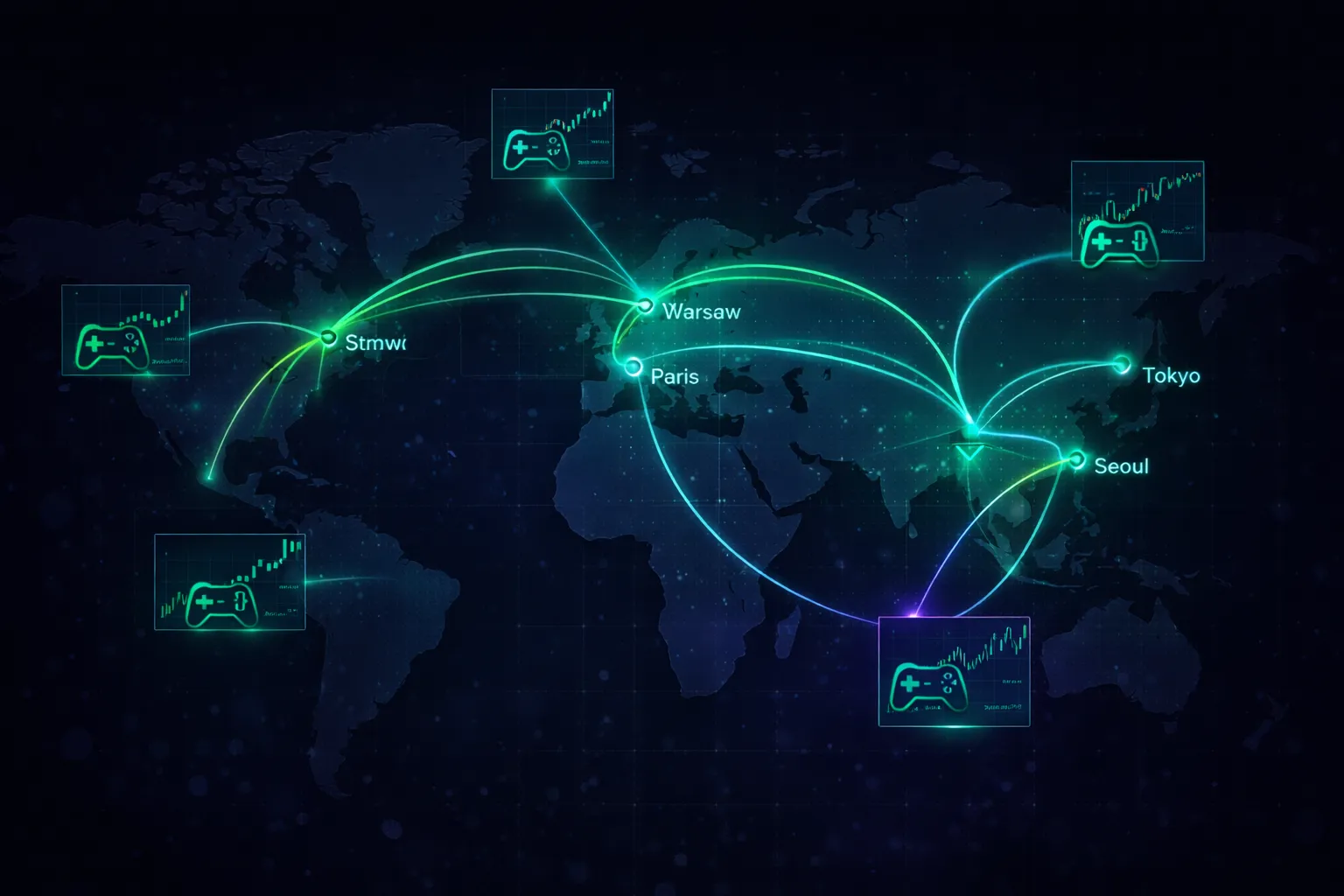
The 28 publishers trade across 8 exchanges in 3 time zones, and the time gaps between information and market reaction create some of the clearest opportunities in the dataset.
Asia (14 companies): Tokyo Stock Exchange, Korea Exchange, KOSDAQ. Japanese and Korean publishers dominate. These exchanges open when most Western review embargoes have already lifted, creating a 14+ hour gap between information and price reaction.
Europe (9 companies): Warsaw Stock Exchange, Euronext Paris, OMX Stockholm, Helsinki, London Stock Exchange. European trading hours overlap with US morning, so review events during this window get priced across both regions simultaneously.
Americas (5 companies): NASDAQ and NYSE. Most analyst coverage, most institutional attention, fastest price reaction to review events.
If a major review drops at 10 AM Eastern, Tokyo doesn't open for another 14+ hours. You know the signal before the Asian market has a chance to react. The Gaming Sector widget shows cross-publisher correlation by region, helping you estimate the likely sympathy move before the market opens.
The Rest of the 28
They all matter to the sector picture even if they're not individually as tradeable on review events.
Asia: Square Enix (TSE: 9684) sits between tiers — Final Fantasy is massive but they also have manga, merch, and amusement businesses. Konami (TSE: 9766) has pivoted so far toward fitness clubs and pachislot machines that reviews barely register, but a new Metal Gear or Silent Hill could change that overnight. Sega (TSE: 6460) has Atlus and the Persona franchise alongside Sonic. Nexon (TSE: 3659) and NCSoft (KRX: 036570) are Korean online gaming giants — their stocks react more to monthly active user numbers than critic reviews, but major launches still matter.
Europe: Frontier Developments (LSE: FDEV) makes Planet Coaster and Elite Dangerous — small-cap UK, entirely gaming-dependent, and the stock moves violently on launch reviews. Stillfront (OMX: SF) focuses on mobile and free-to-play, less review-driven but trades with the sector.
Americas: Roblox (NYSE: RBLX) is platform-first, so traditional review events don't apply the same way — but it trades with gaming sector sentiment.
The point isn't that all 28 are equally tradeable. It's that tracking all of them gives you the sector picture: correlation data, sympathy moves, and momentum indicators you miss watching one or two stocks.
How Do Gaming Stocks Correlate During Review Events?
Game publishers don't trade in isolation — when one drops on a bad review, peers in the same region often follow within the same week. When same-direction correlation runs above 60%, a single review event becomes a sector event.
This creates opportunities beyond the direct play. If Publisher A drops 8% on a bad review and Publisher B drops 3% in sympathy despite having no news, Publisher B might be mispriced. Regional clustering makes this more predictable than you'd expect. Japanese publishers correlate more tightly with each other than with European or US publishers — partly from overlapping trading hours, partly shared analyst coverage, partly retail investor overlap.
A 2022 paper by Zhu and colleagues published in the Journal of Corporate Finance found that industry peer effects explain 15-20% of stock price variation during sector-specific information events. Gaming is no exception — and because the information events (review scores) are public and timestamped, the peer effects are unusually tradeable.
The Gaming Sector widget quantifies this with same-direction move percentages between every publisher pair, filterable by region. When that number is above 60%, you're not just trading one stock — you're trading a sector.
What Should You Watch for Right Now?
I'm not going to tell you what to buy. Nydar is a paper trading and analysis platform, not a financial advisor. All of this is probabilistic analysis, not investment advice.
But I will say: the gaming stocks worth watching are the ones with upcoming AAA launches, short review embargo timelines, and Tier 1 revenue concentration. The Game Releases widget shows upcoming launches with embargo countdowns, franchise expected scores, and IGDB hype data. That's where you find the next review event.
If you want to paper trade gaming stocks and test the review thesis with zero risk, Nydar gives you the widgets, the data, and $100K in virtual capital. The learn guide walks through the full playbook — review timeline, risk management around earnings overlap, and how to handle exchange hour mismatches.
The WSB tracker adds another dimension for publishers that also attract retail Reddit attention. When a review event overlaps with WSB momentum, stock moves can amplify significantly. Worth keeping an eye on both signals together.
The pattern repeats every time. Embargo lifts, reviews flood in, the score forms, social buzz amplifies, the stock moves. Whether it goes up or down depends on the deviation from expected — not the raw number. Twenty-eight stocks. Eight exchanges. Three time zones. One thesis.
We track it. You trade it (on paper, until you're ready).
Add the game stocks widgets to your Nydar dashboard and watch how the next review event plays out. Get started free.
Last updated: March 2026
Last updated: Invalid Date