What Is Cryptocurrency?
Cryptocurrency is digital money that runs on blockchain technology - a decentralized network of computers that verifies transactions without banks or governments.
Key Characteristics
Decentralized
No single entity controls it
Secure
Cryptography protects transactions
24/7 Trading
Markets never close
Limited Supply
Many have fixed maximum supply
Major Cryptocurrencies
Bitcoin (BTC)
The original cryptocurrency
Created in 2009, Bitcoin is the largest crypto by market cap. Often called "digital gold" - used as a store of value. Maximum supply: 21 million coins.
Ethereum (ETH)
The smart contract platform
Second largest crypto. Powers DeFi, NFTs, and thousands of tokens. Think of it as a decentralized computer anyone can build on.
Altcoins (Everything Else)
Thousands of other cryptocurrencies exist. Some major categories:
- • Layer 1s: Solana, Cardano, Avalanche (compete with Ethereum)
- • DeFi: Uniswap, Aave, Chainlink (decentralized finance)
- • Stablecoins: USDT, USDC (pegged to $1 USD)
- • Meme coins: DOGE, SHIB (high risk, community-driven)
Beginner Tip: Start with BTC and ETH. They're the most liquid, most stable, and easiest to understand. Add altcoins later once you're comfortable.
How Crypto Trading Works
Trading Pairs
Crypto is traded in pairs. When you see BTC/USDT, it means you're trading Bitcoin against Tether (a stablecoin pegged to USD).
BTC/USDT = 65,000
This means 1 Bitcoin costs 65,000 USDT (roughly $65,000 USD)
Common quote currencies: USDT, USDC, BTC, ETH
Types of Orders
Market Order
Buy/sell immediately at current price. Fast but may get worse price on volatile moves.
Limit Order
Set your own price. Only executes if market reaches that price. Better prices but may not fill.
Stop-Loss Order
Automatically sells if price drops to your level. Essential for risk management.
Spot vs Futures
Spot Trading
Buy and own actual coins. What beginners should use. No leverage, no liquidation risk.
Futures Trading
Trade contracts with leverage. Can profit from falling prices but can lose more than deposit. NOT for beginners.
Understanding Market Cycles
Crypto moves in cycles, often tied to Bitcoin's halving events (every ~4 years). Understanding these can help you time your investments.
Bear Market
Prices fall 70-90%
Lasts 1-2 years
Accumulation
Prices stabilize
Smart money buys
Bull Market
Prices surge 5-20x
Everyone is excited
Distribution
Smart money sells
Maximum FOMO
Pro Tip: "Be fearful when others are greedy, and greedy when others are fearful." The best time to buy is often when everyone is giving up on crypto.
Risk Management for Crypto
Crypto is more volatile than stocks. A 10% move in a day is normal. This requires stricter risk management.
1. Never Risk More Than You Can Lose
Only invest money you won't need for 5+ years. Crypto can drop 80% and stay down for years.
2. Use Wider Stop Losses
Crypto's volatility means tighter stops get hit by normal noise. Consider 5-10% stops instead of 1-2% used for stocks.
3. Dollar-Cost Average (DCA)
Instead of buying all at once, spread your purchases over time. Buy weekly or monthly regardless of price. Reduces timing risk.
4. Diversify (But Not Too Much)
Don't put everything in one coin. But owning 50 different coins is also a mistake. 3-5 carefully researched positions is plenty.
5. Avoid Leverage
Futures and margin trading are how most people blow up their accounts. Crypto is volatile enough without 10x leverage.
Common Mistakes to Avoid
FOMO Buying Pumps
Coin up 100% in a day? You're probably too late. Buying pumps is how you become exit liquidity for early buyers.
Chasing Shitcoins
Low-cap "gems" with 1000x potential usually go to zero. Start with established projects, not random Twitter recommendations.
Not Securing Your Crypto
"Not your keys, not your coins." If you hold significant amounts, use a hardware wallet (Ledger, Trezor). Exchanges can be hacked.
Trading 24/7
Just because markets are open doesn't mean you need to trade constantly. Overtrading leads to burnout and bad decisions.
Ignoring Taxes
In most countries, crypto trades are taxable events. Keep records of all trades. Consider using crypto tax software.
Crypto-Specific Tools
Fear & Greed Index
Measures overall market sentiment from 0 (extreme fear) to 100 (extreme greed). Contrarian indicator - buy when fearful, be cautious when greedy.
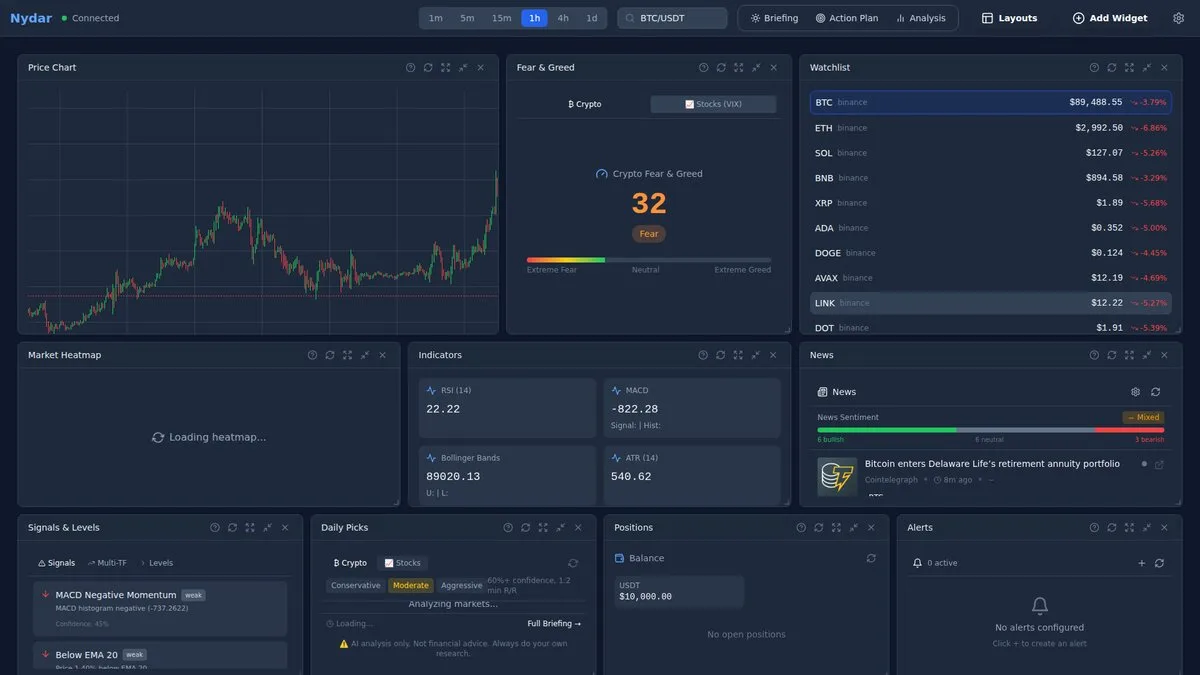
Nydar displays this prominently in the dashboard — updated every 60 seconds alongside Nydar's ML sentiment signals.
Bitcoin Dominance
Bitcoin's percentage of total crypto market cap. High dominance (50%+) = "risk-off" (money in BTC). Low dominance = "alt season" (money flowing to altcoins).
Funding Rates
In futures markets, positive funding = longs pay shorts (too many bulls). Negative = shorts pay longs. Extreme funding often precedes reversals.
On-Chain Data
Exchange inflows/outflows, whale movements, active addresses. Coins moving to exchanges often precedes selling. This data is unique to crypto and very powerful.
Getting Started Checklist
- 1Learn about Bitcoin and Ethereum - understand what you're buying
- 2Paper trade first - get comfortable with volatility
- 3Start small - amounts you can afford to lose completely
- 4Use limit orders and stop-losses
- 5Keep a trading journal - track what works
- 6Learn basic technical analysis
- 7Master risk management - it's everything
Crypto Trading Risks
- • Extreme volatility - 20%+ swings are common
- • Regulatory uncertainty in many countries
- • Scams and rug pulls are rampant in small projects
- • Exchanges can be hacked or go bankrupt
- • No investor protection like stock markets have
- • Many projects fail - most altcoins go to zero eventually
Further Reading
- Investopedia: What is cryptocurrency? — How crypto markets work and key terminology
- FCA: Cryptoassets guidance for consumers — UK financial regulator crypto guidance
Written by Ryan Clinton
Founder of Nydar. Software engineer with experience at Cowen Inc (Wall Street) and on large-scale infrastructure projects. Built Nydar to make professional trading tools accessible to everyone.
Last reviewed: March 2026