Market Sentiment Analysis
Nydar's fear and greed index measures market sentiment across 7 signal components — volatility, momentum, volume, breadth, safe-haven demand, and options data. Learn to read crowd psychology and find contrarian opportunities.
What is Market Sentiment?
Market sentiment is the overall attitude of investors toward a market or asset. It's the collective mood - whether traders feel bullish, bearish, or uncertain. Sentiment often drives prices more than fundamentals in the short term.
Why Sentiment Matters
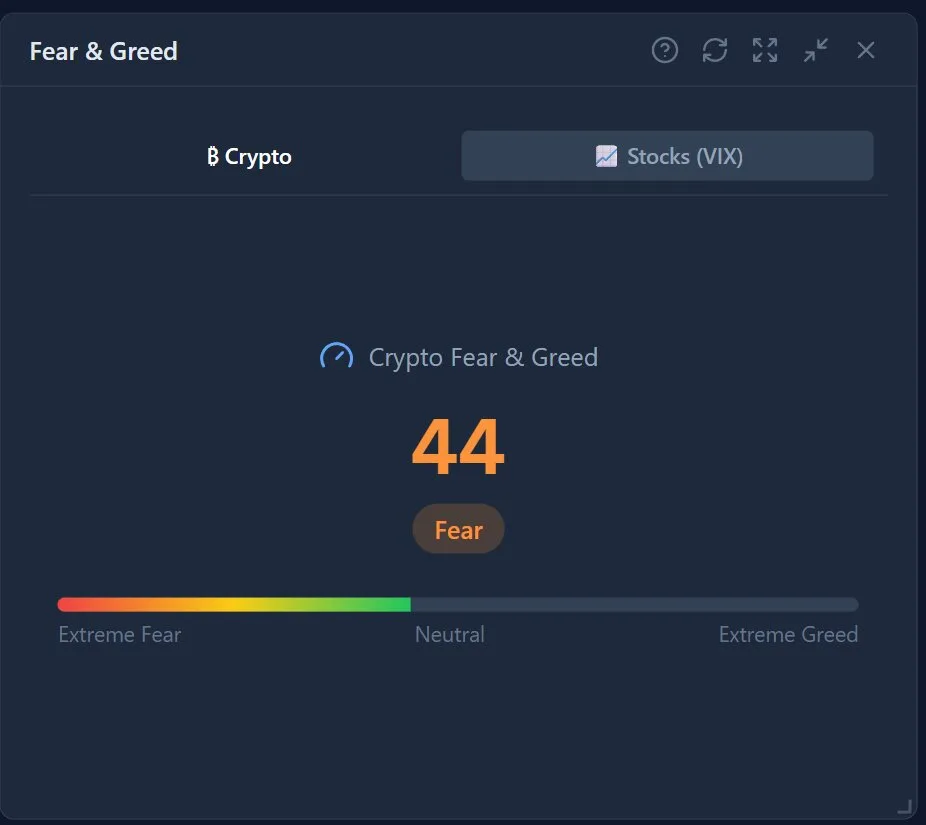
Nydar's fear and greed widget updates in real time on your dashboard, combining 7 signal components into a single 0-100 score. Extreme fear/greed often precedes reversals
Be greedy when others are fearful
Healthy trends have balanced sentiment
Reduce exposure during euphoria
Warren Buffett's Rule: "Be fearful when others are greedy, and greedy when others are fearful." Extreme sentiment readings often mark major turning points.
Fear & Greed Index
The most popular sentiment gauge. Combines multiple indicators into a single 0-100 score measuring overall market emotion. Nydar's Fear & Greed widget displays this in real-time on your dashboard.
Reading the Scale
Extreme Fear (0-25)
Investors are very worried. Panic selling may be overdone. Often a buying opportunity for contrarians.
Extreme Greed (75-100)
Euphoria and FOMO everywhere. Market may be overextended. Time to be cautious or take profits.
Components of Fear & Greed
VIX: The Fear Index
The VIX (Volatility Index) measures expected volatility in the S&P 500 over the next 30 days. Often called the "fear index" because it spikes during market stress.
VIX Levels
| VIX Level | Market Condition | Interpretation |
|---|---|---|
| Below 15 | Low volatility | Complacency - potential storm ahead |
| 15-20 | Normal | Healthy market conditions |
| 20-30 | Elevated | Uncertainty, caution warranted |
| Above 30 | High fear | Panic - often marks bottoms |
VIX Spike Strategy
VIX spikes above 30-40 often mark short-term bottoms. When the VIX spikes and then starts declining while the market stabilizes, it can signal a buying opportunity. But don't catch falling knives - wait for confirmation.
Put/Call Ratio
Measures the ratio of put options (bearish bets) to call options (bullish bets). Shows what options traders are betting on.
Too many calls - contrarian bearish
Balanced sentiment
Too many puts - contrarian bullish
Types of Put/Call Ratios
Social & News Sentiment
Modern sentiment analysis includes social media, news, and online discussions. Nydar's News widget scores headlines by sentiment for any symbol you track.
Social Media Signals
- • Twitter/X mentions and sentiment
- • Reddit discussions (WallStreetBets)
- • StockTwits sentiment scores
- • Discord server activity
News Sentiment
- • Headlines tone (bullish/bearish)
- • Coverage volume spikes
- • Analyst opinion shifts
- • Earnings call sentiment
Social Sentiment Warning
Social media can be manipulated and is often a lagging indicator. When "everyone" is talking about a stock on social media, the move may already be over. Use as confirmation, not primary signal.
Contrarian Trading with Sentiment
The most powerful use of sentiment is contrarian trading - going against the crowd when sentiment reaches extremes.
Contrarian Signals
Bullish Contrarian Setup
- • Fear & Greed below 20
- • VIX spiking above 30
- • Put/Call ratio above 1.2
- • Magazine covers predicting doom
- • "Stocks are dead" headlines
Bearish Contrarian Setup
- • Fear & Greed above 80
- • VIX complacently low (below 12)
- • Put/Call ratio below 0.6
- • "New paradigm" talk everywhere
- • Everyone becoming a day trader
The Magazine Cover Indicator
When a market theme makes the cover of mainstream magazines (Time, Newsweek, The Economist), the trend is often near its end. By the time mainstream media notices, smart money has already positioned.
How to Use Sentiment in Trading
1. As a Filter
Don't go long in extreme greed or short in extreme fear without strong technical reasons. Use sentiment to filter out low-probability trades.
2. As Confirmation
When your technical analysis aligns with extreme sentiment readings, you have a higher probability setup. Multiple confirmations = better odds.
3. For Position Sizing
Reduce position sizes when sentiment is extreme against you. Increase sizes when sentiment supports your thesis at extremes.
4. For Timing
Wait for sentiment to reach extremes before fading the crowd. Neutral sentiment doesn't give you an edge - extremes do.
Common Sentiment Mistakes
Fighting the Trend
"Extreme" can get more extreme. Markets can stay irrational longer than you can stay solvent. Wait for sentiment + price action confirmation before going contrarian.
Using Sentiment Alone
Sentiment should confirm your technical analysis/fundamental analysis, not replace it. A bearish sentiment reading doesn't mean "buy now" - it means "look for bullish setups."
Ignoring Context
Fear during a crisis is different from fear during a normal pullback. Consider why sentiment is extreme, not just that it is.
Key Takeaways
- Fear & Greed extremes: Below 20 or above 80 are most actionable
- VIX spikes: Often mark bottoms, but wait for price confirmation
- Contrarian approach: Works best at extremes, not in normal conditions
- Combine indicators: Multiple sentiment tools aligning = stronger signal
- Use as confirmation: Sentiment supports analysis, doesn't replace it
Related Guides
Track Market Sentiment Live
Add the Fear & Greed widget for real-time sentiment readings, and the News widget for sentiment-scored headlines on any symbol.
Get Started FreeFurther Reading
- Investopedia: Market Sentiment — How crowd psychology drives price action
- Investor.gov: Investing basics — Official US investor education resource
Written by Ryan Clinton
Founder of Nydar. Software engineer with experience at Cowen Inc (Wall Street) and on large-scale infrastructure projects. Built Nydar to make professional trading tools accessible to everyone.
Last reviewed: March 2026