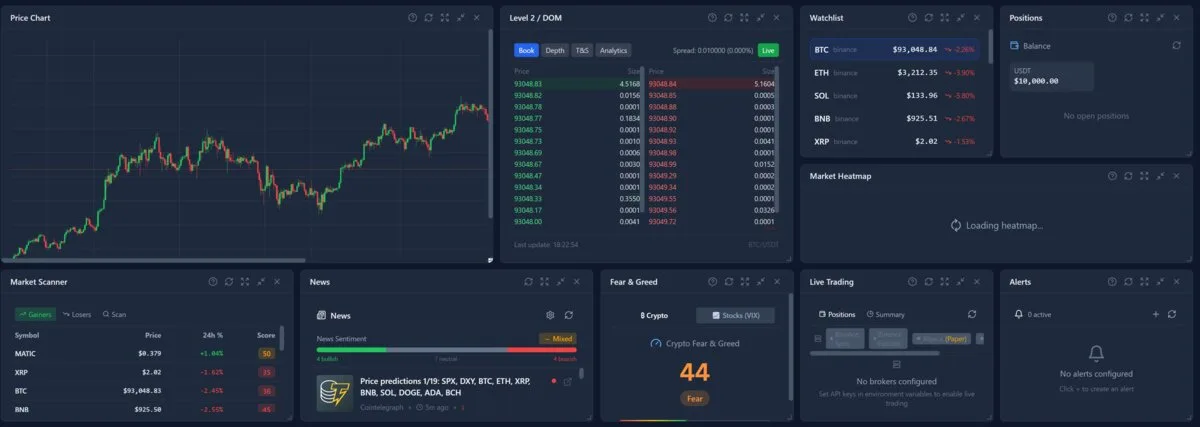
What is Day Trading?
Day trading is a style where you buy and sell financial instruments within the same trading day. All positions are closed before the market closes, so you never hold overnight. This eliminates the risk of gaps and overnight news affecting your positions.
Day traders profit from small price movements, often making dozens of trades per day. Success requires quick decision-making, strict discipline, and solid risk management.
Essential Requirements
5 Proven Day Trading Strategies
1Momentum Trading
Momentum trading means buying stocks that are moving strongly in one direction with high volume. The idea is simple: stocks in motion tend to stay in motion.
How to Trade It:
- Scan for stocks up 5%+ in pre-market with volume
- Wait for the first pullback after market open
- Enter when price bounces off support with increasing volume
- Set stop loss below the pullback low
- Take profit at previous highs or when momentum fades
Example Setup:
Stock gaps up 8% on earnings at open. Within the first 15 minutes, it pulls back from $52 to $49.50 on declining volume. At $49.50 (yesterday's high — now acting as support), volume picks up and a bullish engulfing candle forms on the 5-minute chart.
Entry: $49.75 | Stop: $49.00 | Target: $52.00 (gap high) | Risk:Reward: 1:3
Best conditions: High-volume market open, strong sector movement, clear catalyst (earnings, news). Worst conditions: Low-volume days, choppy markets, no clear catalyst.
2Breakout Trading
Breakout trading involves entering when price breaks above resistance or below support with volume. These levels act as barriers, and when broken, often lead to strong moves.
How to Trade It:
- Identify stocks consolidating near key resistance levels
- Watch for a candle close above resistance with above-average volume
- Enter on the breakout or on a retest of the broken level
- Set stop loss just below the breakout level
- Target the height of the consolidation range added to the breakout point
Example Setup:
Stock has tested $45.00 resistance three times over 2 weeks. On the fourth test, the 5-minute chart shows a strong green candle closing above $45.00 with 3x average volume. You enter at $45.10.
Entry: $45.10 | Stop: $44.70 (below breakout) | Target: $46.50 (range height: $1.50) | Risk:Reward: 1:3.5
Best conditions: Stocks near all-time highs, consolidation patterns (flags, triangles), market trending. Worst conditions: Broad market selling, low-volume afternoons, resistance within a strong downtrend.
3Scalping
Scalping is the fastest form of day trading - holding positions for seconds to minutes, targeting tiny price movements (a few cents per share). Scalpers may make 50-100+ trades per day.
How to Trade It:
- Trade highly liquid stocks/crypto with tight spreads
- Use 1-minute or tick charts
- Enter on small pullbacks within the trend
- Take quick profits (5-20 cents per share)
- Use tight stops and never let small losses become big ones
Best conditions: High-liquidity names (SPY, QQQ, AAPL, BTC), tight bid-ask spread, clear intraday trend. Avoid: Low-volume stocks, wide spreads, choppy midday trading. Read our complete scalping guide for detailed techniques.
4Range Trading
Range trading works in choppy, sideways markets. You buy at support and sell at resistance, profiting from the predictable bounces between these levels.
How to Trade It:
- Identify stocks trading in a clear range (support and resistance)
- Buy when price touches support with a bullish reversal candle
- Sell when price approaches resistance
- Use RSI to confirm oversold/overbought conditions
- Exit immediately if price breaks out of the range
Example Setup:
Stock has bounced between $30 support and $32 resistance four times in 3 days. Price touches $30.10 again, RSI is at 28 (oversold), and a hammer candle forms on the 15-minute chart.
Entry: $30.25 | Stop: $29.80 (below range) | Target: $31.80 (near resistance) | Risk:Reward: 1:3.4
5News-Based Trading
News trading capitalizes on volatility around earnings reports, economic data, or company announcements. Prices can move 10%+ in minutes on significant news.
How to Trade It:
- Monitor earnings calendars and economic event schedules
- Wait for the initial reaction to settle (avoid the first 5 minutes)
- Trade the secondary move in the direction of the news
- Use wider stops due to increased volatility
- Be prepared to exit quickly if the move reverses
Example Setup:
Company beats earnings estimates by 15%. Stock gaps up 10% at open, spikes to $88 in the first 5 minutes, then settles back to $84 as early profit-takers sell. After 15 minutes, buying resumes and price breaks above $85 with volume — this is the secondary move.
Entry: $85.20 | Stop: $83.50 (below consolidation) | Target: $88.00 (opening spike high) | Risk:Reward: 1:1.6
Pre-Market Preparation Routine
Professional day traders don't start trading at market open — they start preparing 30-60 minutes before. A good pre-market routine is the difference between reacting and planning:
Best Times to Day Trade
Not all hours are created equal. Volume and volatility — what day traders need — concentrate at specific times:
| Time (ET) | Session | Character | Best Strategy |
|---|---|---|---|
| 9:30 - 10:30 | Opening Hour | Highest volume, widest ranges, fast moves | Momentum, Breakout |
| 10:30 - 12:00 | Mid-Morning | Trends establish, volume moderate | Breakout, Range |
| 12:00 - 2:00 | Lunch Doldrums | Low volume, choppy, many false signals | Avoid (or scalp only) |
| 2:00 - 3:00 | Afternoon Setup | Volume picks up, institutional activity resumes | Breakout, Momentum |
| 3:00 - 4:00 | Power Hour | Second highest volume, end-of-day positioning | Momentum, News |
Crypto traders: Crypto markets are 24/7, but volume peaks during US market hours (9:30 AM - 4:00 PM ET) and again during the Asian session (8:00 PM - 2:00 AM ET).
Which Strategy Suits You?
Don't try to master all five strategies at once. Pick one that matches your personality and market conditions:
| If You... | Try This Strategy | Market Condition |
|---|---|---|
| Like fast action, quick decisions | Momentum or Scalping | Trending, high volume |
| Prefer patience, waiting for the right setup | Breakout | Consolidation near key levels |
| Like predictable, repeatable setups | Range Trading | Sideways, low ADX |
| Follow market news closely | News-Based | Earnings season, data releases |
Start by paper trading one strategy for at least 2 weeks. Track every trade in your trading journal. Only move to real money once you're consistently profitable on paper.
Risk Management Rules
Risk management separates successful day traders from those who blow up their accounts. Follow these rules religiously:
Common Mistakes to Avoid
Getting Started with Nydar
Nydar provides everything you need to day trade effectively:
- AI-Powered Signals - Get buy/sell alerts based on the strategies above
- Real-Time Scanner - Find momentum stocks and breakout candidates automatically
- Short Squeeze Scanner - Identify high short interest stocks with squeeze potential
- Market Breadth - Check sector health before committing to trades
- Level 2 Data - See the order book to understand supply and demand
- Paper Trading - Practice all these strategies risk-free with $100K virtual capital
- Trading Journal - Track and analyze your trades to improve over time
Further Reading
- Investopedia: Introduction to Day Trading — Momentum, breakout, and gap strategies
- SEC: Day Trading — Your Dollars at Risk — US securities regulator investor alert
Written by Ryan Clinton
Founder of Nydar. Software engineer with experience at Cowen Inc (Wall Street) and on large-scale infrastructure projects. Built Nydar to make professional trading tools accessible to everyone.
Last reviewed: March 2026