What is Paper Trading?
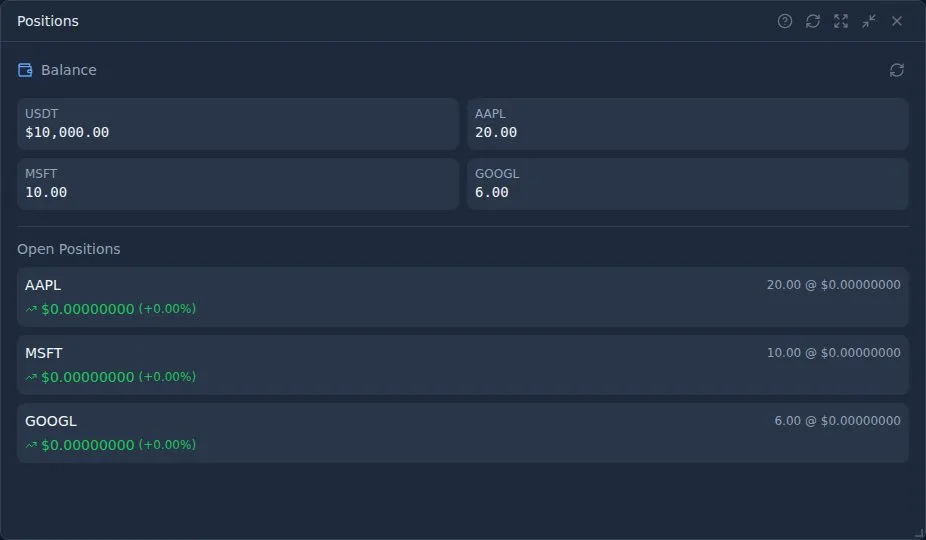
Paper trading is simulated trading using virtual money instead of real funds. It allows you to practice buying and selling stocks, crypto, or forex in real market conditions without any financial risk.
The name comes from the old practice of writing trades on paper to track hypothetical performance. Today, Nydar provides a realistic paper trading environment with real-time prices, professional charting, and portfolio analytics.
Why Paper Trade?
How to Paper Trade Effectively
1. Treat It Like Real Money
The biggest mistake paper traders make is not taking it seriously. If you wouldn't risk $10,000 on a real trade, don't do it in paper trading either. Use realistic position sizes based on proper risk management.
2. Follow a Trading Plan
Write down your strategy before you trade. What setups are you looking for? Where will you enter and exit? What's your risk per trade? Having a plan prevents emotional decisions.
3. Keep a Trading Journal
Record every trade with your reasoning, entry/exit prices, and outcome. Review your journal weekly to identify patterns in your trading - both good habits and mistakes to avoid.
4. Practice Risk Management
Always use stop losses. Never risk more than 1-2% of your account on a single trade (see our Risk Management Guide). These habits are essential for long-term survival in real trading.
5. Give It Time
Paper trade for at least 3-6 months before considering real money. You need to experience different market conditions - trending markets, choppy markets, and unexpected news events.
Important Limitation
Paper trading can't fully replicate the psychological pressure of real money. You may trade differently when actual dollars are on the line. Use paper trading to master mechanics and strategy, but understand that emotional discipline is developed with real (small) stakes.
When to Go Live
Consider moving to real trading when you can answer "yes" to all of these:
- You've been consistently profitable for 3+ months
- You follow your trading plan without emotional deviations
- You use proper risk management on every trade
- You've experienced and survived a losing streak
- You understand why your strategy works (not just that it works)
Paper Trading Milestones
Track your progress through these milestones to know you're developing as a trader:
Month 1: Learning the Mechanics
Focus on understanding order types (market, limit, stop), reading charts, and using basic indicators. Don't worry about profitability yet — focus on executing trades correctly.
Months 2-3: Developing a Strategy
Start testing specific strategies. Pick ONE approach (e.g., trend following) and trade it consistently. Track every trade in your journal. This is where most beginners get impatient — resist the urge to switch strategies every week.
Months 4-6: Refining and Proving
By now you should have a clear strategy with documented results. Review your journal for patterns. Are you profitable? What's your win rate? What's your average R:R? If your edge is positive and consistent, you may be ready for live trading.
Common Paper Trading Mistakes
Using Unrealistic Size
Trading $1M positions when you'll realistically start with $5,000. Paper trade with the account size you'll actually use — the lessons transfer better.
Not Taking It Seriously
YOLOing paper trades because "it's not real money" builds terrible habits. Trade paper exactly how you'd trade real money — it's practice, not a game.
Strategy Hopping
Switching strategies after 3 losses. Every strategy has losing streaks. Give each approach at least 50 trades before evaluating it. Read our Building a Trading Plan guide to stay disciplined.
Skipping the Journal
Paper trading without a journal is just watching numbers change. The journal is where the actual learning happens. See our Trade Journals guide.
Transitioning to Live Trading
When you're ready to go live, follow this gradual approach to manage the psychological transition:
- Start with micro-size: Begin with 10-25% of your planned position sizes. The goal is to experience real money emotions, not to profit.
- Scale up slowly: After 2-4 weeks of disciplined micro-trading, increase to 50%. Then 75%. Then full size. Each step up will feel different psychologically.
- Keep paper trading alongside: Run paper trades in parallel to compare your execution. If your real results are significantly worse, the gap is psychology — not strategy.
- Have a "blow-up" plan: Decide in advance: "If I lose X% of my account, I go back to paper trading for 2 weeks." This prevents catastrophic spirals.
Getting Started with Nydar
Nydar's paper trading simulator gives you $100,000 in virtual capital with real-time market data, AI trading signals, 105 technical indicators, and portfolio analytics — all the tools you need to learn trading properly.
Further Reading
- Investor.gov introduction to investing — Official US investor education resource
- FCA guide to understanding investment risk — UK financial regulator consumer guidance
Written by Ryan Clinton
Founder of Nydar. Software engineer with experience at Cowen Inc (Wall Street) and on large-scale infrastructure projects. Built Nydar to make professional trading tools accessible to everyone.
Last reviewed: March 2026