What is Trend Following?
Trend following is a trading strategy that aims to capture gains by riding the momentum of market trends. Rather than predicting where prices will go, trend followers wait for a trend to establish itself, then position in the direction of that trend until it shows signs of reversing.
Core Principles of Trend Following
Follow, Don't Predict
React to what the market is doing, not what you think it will do
Cut Losses Quickly
Exit fast when trends fail to protect capital
Let Winners Run
Stay in winning trades as long as the trend continues
Accept Many Small Losses
A few big winners cover many small losses
The Math Behind Trend Following
Trend followers often have a win rate below 50%, but remain profitable because their average winner is much larger than their average loser. If you win 40% of the time but your winners are 3x your losers, you're still profitable: (0.40 × 3) - (0.60 × 1) = 0.60 expected value per trade.
Identifying Trends
Before you can follow a trend, you need to identify one. Here are the most reliable methods for determining trend direction and strength. You can apply these using the Indicators widget to overlay moving averages and ADX directly on your charts.
Moving Average Methods
Price vs. Moving Average
- • Uptrend: Price above 50 or 200 MA
- • Downtrend: Price below 50 or 200 MA
- • Use longer moving averages (50, 100, 200) for more reliable signals
MA Crossovers
- • Golden Cross: 50 MA crosses above 200 MA (bullish)
- • Death Cross: 50 MA crosses below 200 MA (bearish)
- • Faster combo: 10 MA crossing 30 MA for quicker signals
Higher Highs and Higher Lows
The classic definition of a trend based on price structure alone.
Uptrend
- • Each swing high higher than previous
- • Each swing low higher than previous
- • Trend intact until lower low forms
Downtrend
- • Each swing low lower than previous
- • Each swing high lower than previous
- • Trend intact until higher high forms
ADX (Average Directional Index)
ADX measures trend strength on a scale of 0-100, regardless of direction. Nydar's Indicators widget includes ADX alongside 104 other technical indicators.
ADX Readings:
- • 0-20: Weak or no trend (avoid trend following)
- • 20-40: Developing trend (good entry zone)
- • 40-60: Strong trend (ride the move)
- • 60+: Very strong trend (may be overextended)
Trend Following Systems
1. The Turtle Trading System
Made famous by Richard Dennis and William Eckhardt, this system uses breakouts to enter and trailing stops to exit.
Rules:
- • Entry: Buy when price breaks 20-day high
- • Exit: Sell when price breaks 10-day low
- • Stop: 2× ATR from entry
- • Position Size: Risk 1% per trade based on ATR
2. Moving Average Crossover
Simple but effective system using two moving averages.
Rules (10/30 EMA System):
- • Buy: 10 EMA crosses above 30 EMA
- • Sell: 10 EMA crosses below 30 EMA
- • Filter: Only trade in direction of 200 MA
- • Stop: Below recent swing low (longs) or swing high (shorts)
3. Pullback Entry System
Enter established trends on pullbacks for better risk/reward.
Rules:
- • Confirm trend: Price above 50 MA, ADX above 25
- • Wait for pullback: Price retraces to 20 EMA
- • Entry: Buy when price bounces off 20 EMA
- • Stop: Below the pullback low
- • Target: Trail stop using 20 EMA
Entry Techniques
Breakout Entry
Enter when price breaks out to new highs/lows.
- Catches moves early
- Clear entry point
- More false breakouts
Pullback Entry
Wait for retracement within the trend.
- Better entry price
- Tighter stop losses
- May miss fast moves
Exit Strategies
The exit is more important than the entry in trend following. Your stop loss and exit strategy determines whether you let winners run or cut them short.
Trailing Stop Methods
ATR Trailing Stop
Trail stop 2-3× ATR below price. Adapts to market volatility automatically.
Moving Average Stop
Exit when price closes below a key MA (20 EMA for active, 50 MA for longer holds).
Swing Low Stop
Trail stop below each new swing low. Classic price structure approach.
Percentage Stop
Trail stop a fixed percentage (e.g., 10%) below the highest close.
Don't Exit Too Early
The biggest mistake trend followers make is taking profits too quickly. A trend can run much further than you expect. Let your trailing stop do the work—don't exit just because you have a profit.
Risk Management for Trend Following
Position Sizing Rules
Risk Per Trade: 1-2%
Never risk more than 1-2% of your account on a single trade. This allows you to survive the inevitable losing streaks.
ATR-Based Sizing
Calculate position size based on ATR so volatile assets get smaller positions and stable assets get larger positions.
Correlation Awareness
Don't take 10 trend-following positions in correlated assets. If they all reverse together, your losses multiply.
When Trend Following Struggles
Challenging Conditions
- Range-bound, sideways markets
- Choppy price action with no follow-through
- V-shaped reversals (sharp reversals)
- Low volatility environments
Ideal Conditions
- Strong directional moves
- Clear higher highs/higher lows
- Extended trending periods
- Moderate to high volatility
Use ADX as a Filter
Only take trend-following trades when ADX is above 25. Below that, the market is likely range-bound and trend-following will underperform. Consider mean-reversion strategies in low-ADX environments instead.
Key Takeaways
- 1
Follow the trend, don't predict it
React to what the market is doing, not what you think it will do.
- 2
Cut losses quickly, let winners run
A few big winners will cover many small losses if you manage exits properly.
- 3
Use trailing stops religiously
ATR-based or MA-based trailing stops keep you in trends while protecting gains.
- 4
Accept drawdowns as part of the process
Range-bound markets will cause losses. Stick to the system through choppy periods.
- 5
Filter with ADX
Only trend follow when ADX confirms a trend exists (above 25).
Practice Trend Following Risk-Free
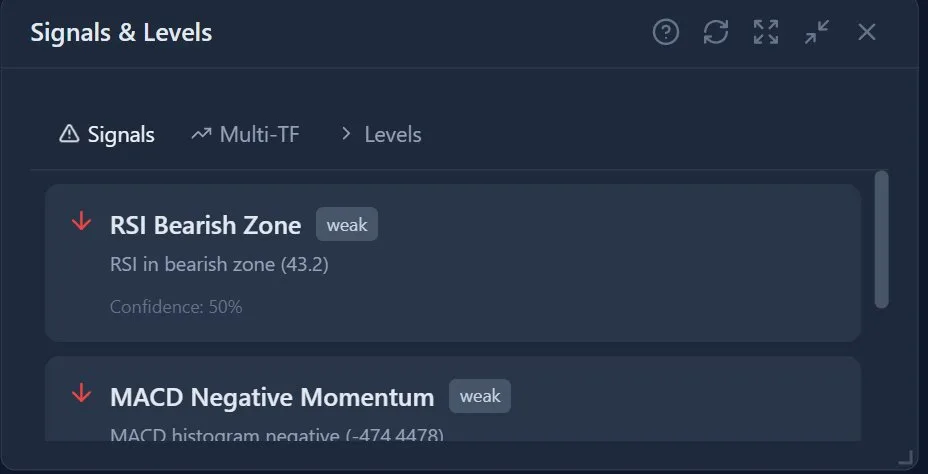
Use the Signals widget to identify trending stocks, and the Indicators widget to confirm trend strength with ADX and moving averages.
Get Started FreeFurther Reading
- Investopedia: Trend Trading strategies — Trend identification and riding momentum
- CME Group: Technical analysis education — Derivatives exchange educational resource
Written by Ryan Clinton
Founder of Nydar. Software engineer with experience at Cowen Inc (Wall Street) and on large-scale infrastructure projects. Built Nydar to make professional trading tools accessible to everyone.
Last reviewed: March 2026